

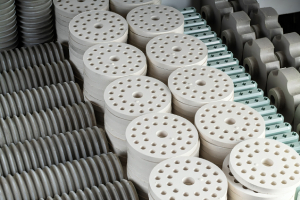
Equipment and components used in extreme environments, including those with harsh persistent or fluctuating temperatures, pressures, or exposure to chemicals and moisture, need the added protection and durability of high-performance materials. Aerospace, electronics, oil and gas, or nuclear applications often involve operating conditions that exceed the capabilities of traditional materials.
In situations like these, engineered technical ceramic components are an excellent alternative because they are compatible with a larger range of environmental conditions, manufacturing tolerances, and service life requirements in mission-critical equipment.
For engineers and Tier 1–2 suppliers who work with these types of applications, understanding when and why to specify technical ceramics helps unlock new design solutions while reducing long-term risk. Learn more about what technical ceramics are, their advantages over traditional materials, and how they are used across industries.
What Are Technical Ceramics?
Technical ceramics, sometimes referred to as advanced or industrial ceramics, are designed for specific types of functional performance rather than decorative use. These materials are manufactured under tightly controlled conditions in different compositions to achieve specific mechanical, thermal, electrical, and chemical properties.
They are generally Non-metallic oxides, carbides, or nitrides that are developed to exhibit the combination of hardness, thermal stability, chemical resistance, compressive strength, porosity, conductivity, or resistance needed for a given application.
Technical ceramics are rarely off-the-shelf materials. In most cases, they are custom formulations with exact dimensional, environmental, and performance requirements in mind for a specific application.
Examples of common technical ceramics include:
- Alumina (Al₂O₃): A widely used, with excellent electrical insulation, wear resistance, and chemical stability.
- Zirconia (ZrO₂): Known for improved fracture toughness and resistance to crack propagation for mechanically demanding environments.
- Silicon Nitride (Si₃N₄): High strength at elevated temperatures, low thermal expansion, and resistance to thermal shock.
- Boron Nitride (BN): Thermal conductivity with electrical insulation for high-temperature and vacuum applications.
Advantages of Technical Ceramics Over Traditional Materials
Technical ceramics offer performance advantages when compared to the reliability and replacement associated with most traditional materials, over the lifecycle of the component. Industry research consistently shows that engineered ceramics outperform traditional materials in environments that involve heat, corrosion, wear, electrical stress, or a combination of these factors.
For critical systems, the advantages below reduce downtime, limit maintenance requirements, and support consistent performance over long operating cycles:
- High-temperature capability. Ceramics retain strength and dimensional stability in temperatures at which traditional materials may soften or creep.
- Corrosion and chemical resistance. Industrial ceramics are largely inert, making them well-suited for aggressive or reactive environments.
- Electrical insulation. Many technical ceramics provide excellent dielectric properties for electronic and high-voltage applications.
- Wear resistance. Ceramic surfaces resist abrasion and erosion, extending component life in high-friction systems.
- Thermal stability. Ceramics have a low coefficient of thermal expansion, which helps with dimensional stability across wide temperature ranges.
Considerations for Ceramic Component Design
While technical ceramics offer exceptional performance, their successful implementation depends on choosing the right type, as noted above, and taking some mechanical and physical properties into consideration. Ceramics behave differently from traditional materials in many cases, and which can change design parameters.
Key considerations include:
- Brittleness. Ceramics have limited ductility and are more sensitive to impact and tensile loading than many traditional materials.
- Load orientation. Compressive loading and controlled stress distribution are important for durability.
- Manufacturing precision. Achieving tight tolerances and precision surface finishes requires close collaboration between engineers and the ceramics manufacturer.
Some Applications for Industrial Ceramics
Engineered ceramic components are used for high-performance parts and components in many industries, including:
- Oil and gas. Wear- and corrosion-resistant components for downhole tools, sensors, and sealing applications.
- Electronics. Substrates, insulators, and thermal management components for high-voltage and high-frequency systems.
- Aerospace. Lightweight, high-temperature components for engines, instrumentation, and insulation systems.
- Automotive. Precision ceramic parts are used in sensors, ignition systems, and wear-critical assemblies.
- Food and beverage. Non-reactive, hygienic components for processing equipment.
- Nuclear. Radiation-resistant components for control, monitoring, and safety systems.
Technical Ceramics Manufacturing from C‑Mac International
Industrial ceramics are high-performance materials, but using them successfully depends on engineering expertise, manufacturing control, and the ability to produce consistent, high-precision parts.
C-Mac International specializes in custom-engineered technical ceramic components, working closely with customers to select the right material, optimize designs, and manufacture components that meet application requirements. By partnering early in the design process, engineers can leverage ceramics to improve reliability, extend component life, and solve challenges that traditional materials cannot.
If your application pushes the limits of traditional materials, engineered technical ceramics may be the solution. Connect with C-Mac to explore how custom ceramic manufacturing can support your next design challenge.
