




Alumina ceramic (Aluminum Oxide) is a particularly hard and dense material that provides superior strength compared to conventional metals and polymers. They are also excellent electrical insulators, ideal for electronic and other engineering applications. Partnering with an Alumina ceramic components manufacturing specialist like C-Mac International can help you realize the full benefits of these materials.
What Is Alumina Ceramic (Aluminum Oxide)?
Alumina ceramic parts consist of Aluminum Oxide (Al2O3), or a combination of aluminum and oxygen. Alumina ceramics also fall under multiple subdivisions based on the percentage of Alumina content, which typically ranges from 80% to over 99%. The more Alumina present within the Alumina ceramic parts, the more enhanced their material properties, including corrosion resistance and density.
C-Mac Alumina Grades
C-Mac International offers six precision-engineered alumina grades ranging from 95% to 99.8% purity. Each grade is optimized for specific performance requirements and application demands. Higher purity grades provide enhanced mechanical strength, thermal conductivity, and dielectric properties, while lower purity grades offer cost-effective solutions for less demanding applications.
The table below details the technical specifications for each C-MAC alumina grade:
Property
Units
CMAC
95CMAC
97CMAC
99CMAC
995CMAC
997CMAC
998
Alumina Purity (Al₂O₃)
%
95%
97%
99%
99.5%
99.7%
99.8%
PHYSICAL PROPERTIES
Density
g/cm³
3.7
3.8
3.88
3.9
3.9
3.9
Water Absorption
%
0
0
0
0
0
0
Color
–
White
White
Ivory
Ivory
Ivory
Ivory
MECHANICAL PROPERTIES
Vickers Hardness (500g)
GPa
13.0
14.0
15.5
16.0
17.2
17.2
Flexural Strength (20°C)
MPa
320
350
350
370
380
380
Compressive Strength
MPa
1960
2200
2250
2300
2350
2350
Young’s Modulus
GPa
310
320
350
360
360
360
Poisson Ratio
–
0.2-0.3
0.2-0.3
0.2-0.3
0.2-0.3
0.2-0.3
0.2-0.3
Fracture Toughness
MPa·m^½
3-4
3-4
3-4
4-5
4-5
4-5
THERMAL PROPERTIES
Coeff. Linear Expansion
×10⁻⁶/°C
7.2
7.2
7.3
7.3
7.3
7.2
Thermal Conductivity
W/(m·K)
22
24
27
28
30
30
Max Operating Temp
°C
1600
1600
1650
1700
1700
1700
Specific Heat
J/(g·K)
0.78
0.78
0.79
0.78
0.79
0.78
Heat Shock Resistance
°C
200
200
200
200
200
200
ELECTRICAL PROPERTIES
Volume Resistivity (20°C)
Ω·cm
>10¹⁴
>10¹⁴
>10¹⁴
>10¹⁴
>10¹⁴
>10¹⁴
Volume Resistivity (300°C)
Ω·cm
>10¹²
>10²
>10²
>10²
>10²
>10²
Dielectric Strength
kV/mm
15
15
15
15
15
15
Alumina Ceramic Properties
Alumina ceramic offers numerous favorable properties that make it ideal for use in many applications.
High Temperature Resistance
Alumina ceramic provides exceptional resistance to high temperatures and corrosion. The reason for this is Alumina’s excellent mechanical strength in high-heat environments and its high melting point, but mechanical strength and thermal shock resistance decrease at temperatures exceeding 1000 °C (1832 °F).
Abrasion Resistance
Alumina ceramic is highly resistant to abrasion, making it suitable for many environments where parts are exposed to extreme wear over time. Unlike conventional metals, Alumina ceramic hardness prevents repeated impacts from compromising part integrity.
Density
Aluminum Oxide has a higher density than other types of metal oxides, usually ranging from around 3.90 to 4.2 g/cm3. Generally, density will depend on the overall structure of the material and its specific composition.
Chemical Resistance
High-purity Alumina can resist chemical corrosion in harsh environments, which is why it’s often a primary choice for engineering many types of components. The reason for this material’s high resistance to corrosion is its low solubility in many types of harsh chemicals.
Dielectric Properties
Alumina’s low dielectric losses and high volume resistivity make it a reliable insulator for a wide range of electrical applications, including capacitors, thick and thin film ceramic substrates, and thin film hybrid integrated circuits.
Alumina Ceramic Applications
With the help of the right Alumina ceramic parts manufacturer, your products or manufacturing processes can benefit greatly from implementing these materials. Here are some of the most common industries that use Alumina ceramic components for their robust properties:
- Oil and gas
- Electronics
- Refractory
- Food and beverage
- Welding
- Aerospace/Defense
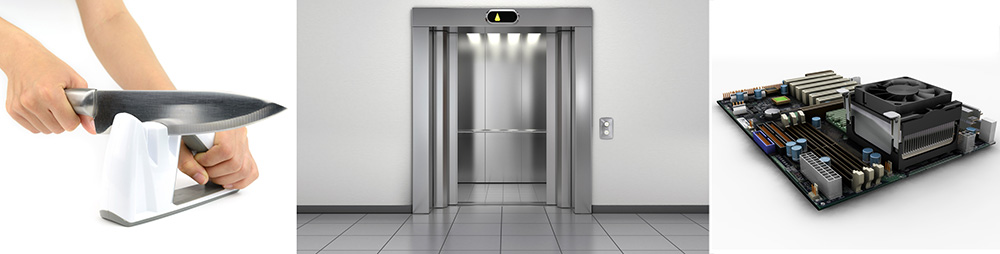
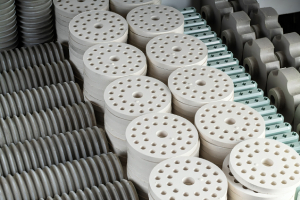
Some of the specific parts and assemblies that rely on Alumina ceramic include:
- Beads
- Balls
- Bearings
- Discs
- Heat sinks
- Knife sharpeners
- Mechanical seals
- Nozzles
- Porous tubes
- Pump seals
- Rollers
- Shafts and cylinders
- Solid and square rods
- Temperature sensors
- Thin film hybrid integrated circuits
- Trays
- Washers
A reliable Alumina ceramic components manufacturer can help you determine what your application requires, matching you with the best product.
Alumina Ceramic Component Manufacturing From C-Mac
C-Mac International is a top Alumina ceramic manufacturer with more than 100 years of collective experience in the industry, developing innovative technical ceramic and tungsten carbide products.
We specialize in Alumina (up to 99.8% pure), Boron Nitride, Silicon Nitride, Zirconia, and Tungsten Carbide to deliver reliable products for critical or highly regulated applications. With efficient operations and competitive pricing, we provide 24-hour turnarounds on quotes, design and manufacture custom parts quickly, and stock customer materials for six to 12 months.
To maintain quality across all of our products, we maintain ISO 9001:2015 and NSF certification. In addition to Alumina ceramics, we offer a wide range of materials with various beneficial properties, including Steatite, Cordierite, crushable ceramics, and Magnesia partially stabilized Zirconia.
To learn more about our capabilities or get started on material selection, contact us today.